The Main Gateway
I went back to India to paint and draw in February and March this year. I flew to Delhi and took a car to Rajasthan to revisit some old places and to see some new ones. I travelled with the photographer Deborah Wastie [see her atmospheric and beautiful images of food, people and places on her Instagram site: @alchemyofordinarythings]. I wanted to paint more scenes of daily life at Makunda, the haveli in Mukundgarh where I first stayed a year ago. You learn so much more about life in India when you stay in a house, a home, than you do in a hotel.
House Work At The Haveli
Working In The Garden & Feeding The Cows
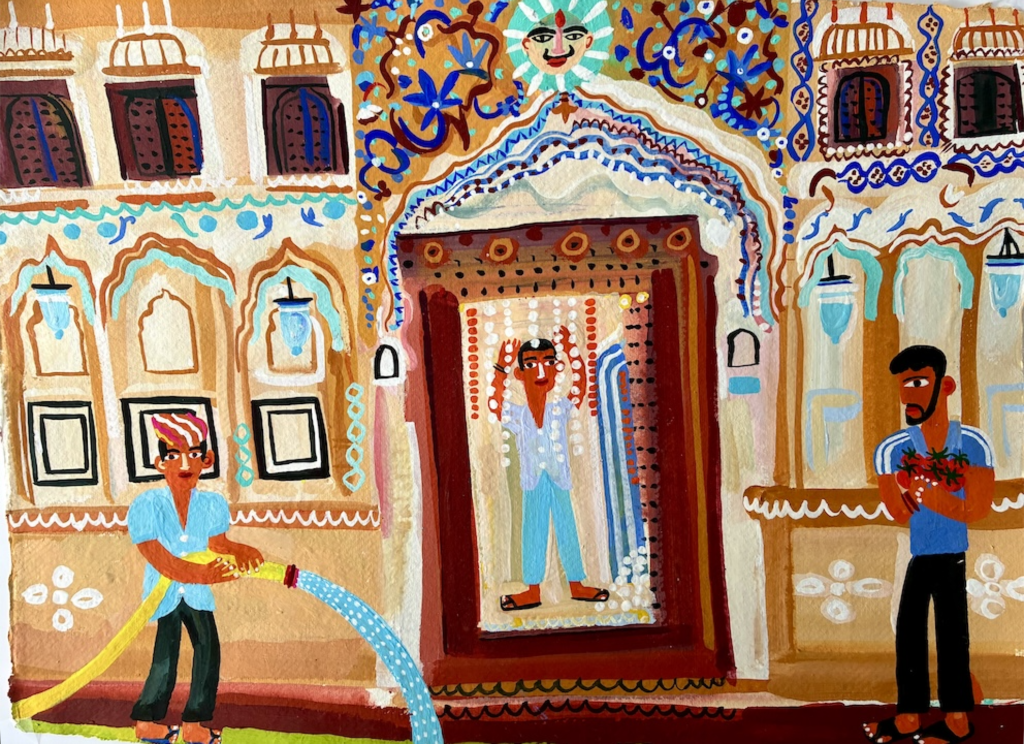
It’s so good to see everyday life all around in an Indian household from sunrise to sunset. It begins so gently with the dressing of the house shrine and the lighting of incense. Slowly the house wakes up and everyone begins their tasks for the day. The cowman comes to milk the house cow and to check on her calf. The cook is in the garden choosing herbs and vegetables for lunch.
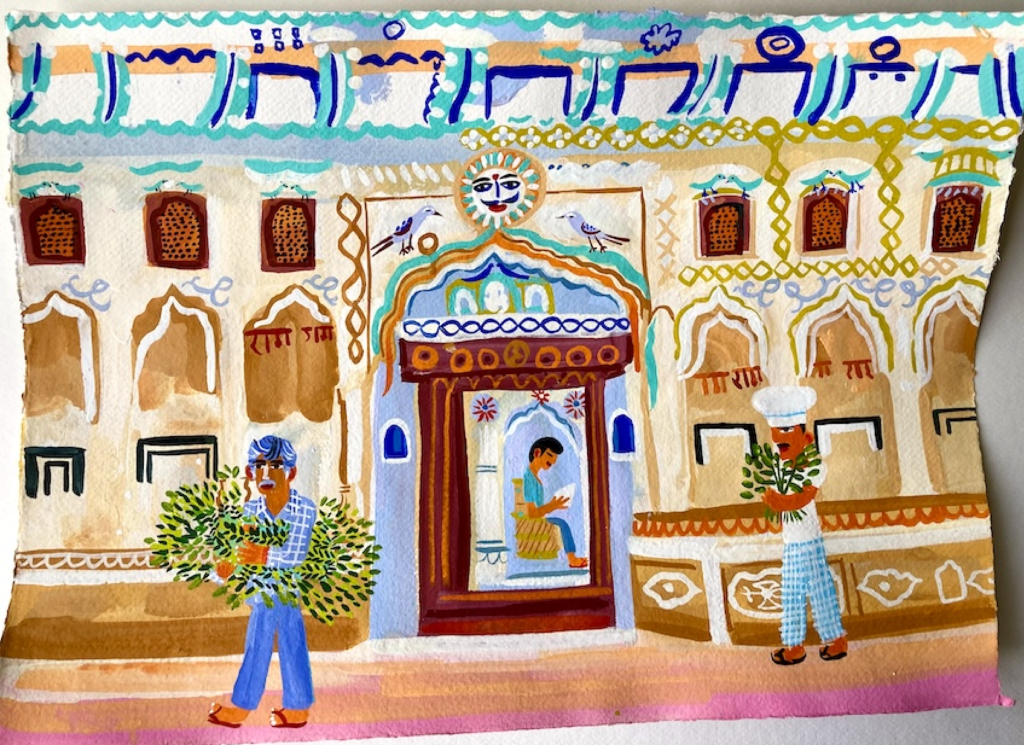
Leaves For The Cow & Greens For Dinner
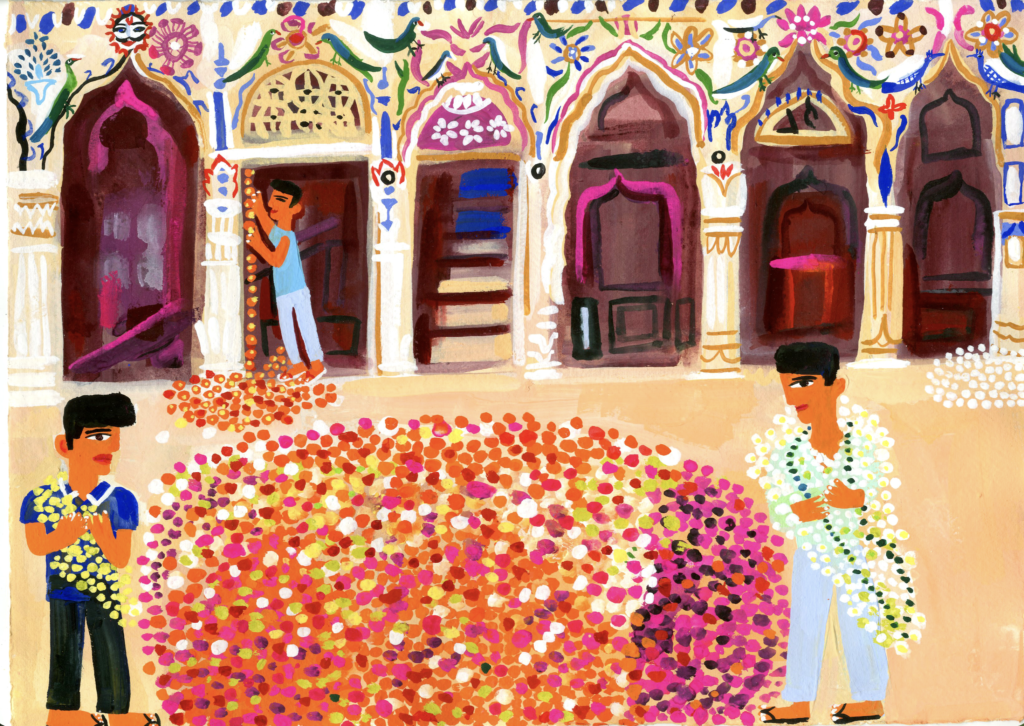
Collecting Marigolds & Rose Petals
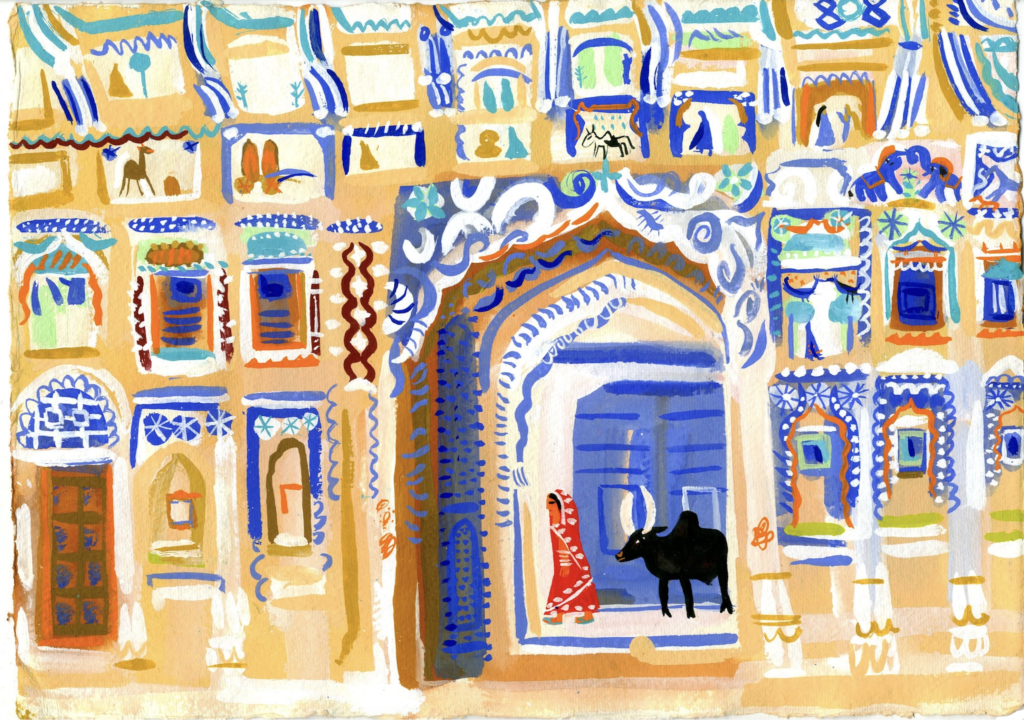
The Gateway
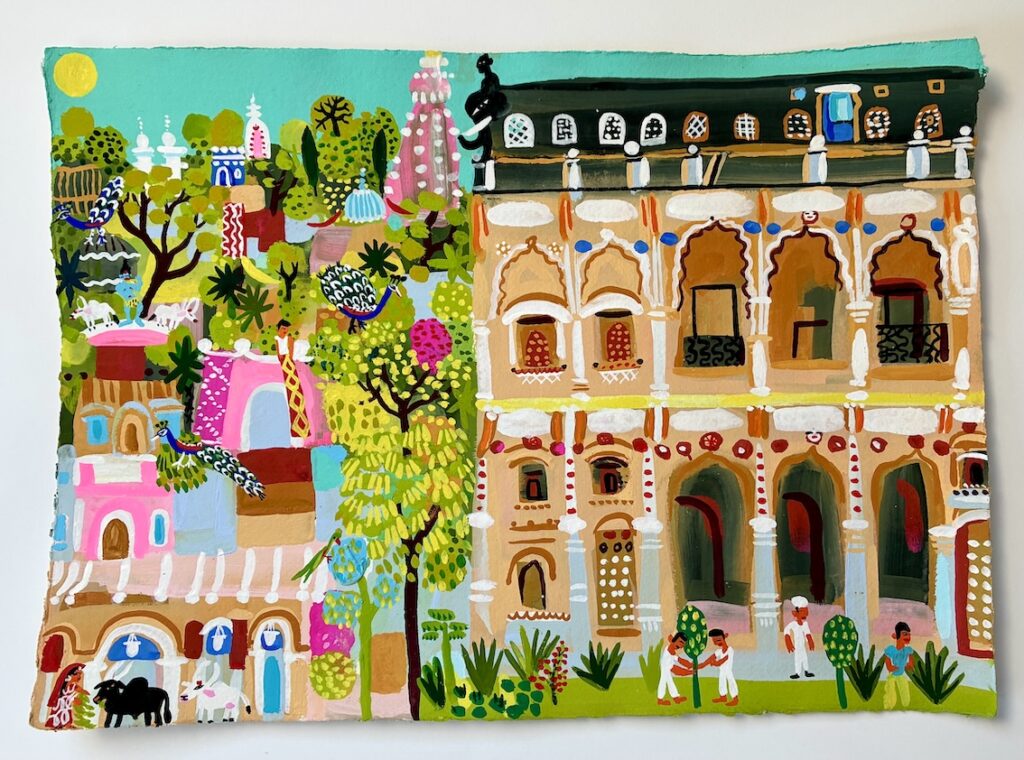
One of the men is grinding red chillies, and preparing vegetables from the garden. Pots and pans are scrubbed and left to dry by the fountain pool. Someone is sweeping the house courtyards that are open to the skies. There is always so much to see as you walk through the house and the garden, wherever you happen to be. The house has a flat roof with spectacular views across the town and out to the Thar Desert. It’s a great place to paint from and a good place to see the layout of the town.
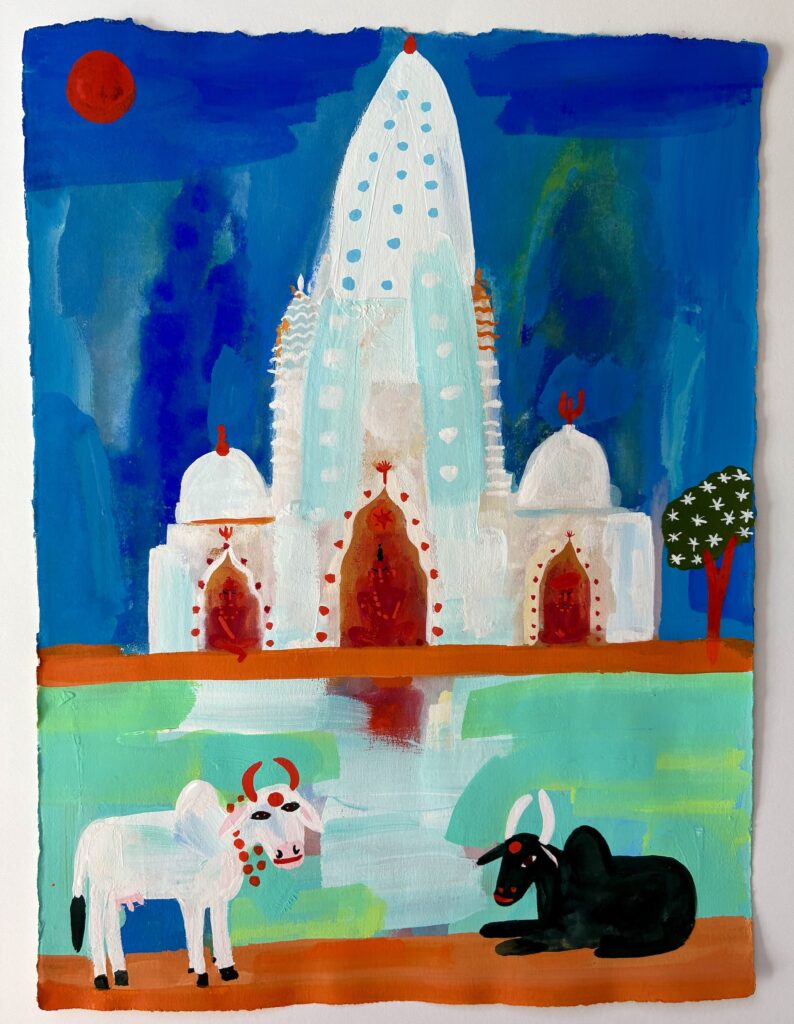
Temple By A River
I look for distinctive temples and mosques, the Cow House and the more elaborate wells to use as landmarks while navigating Mukundgarh.
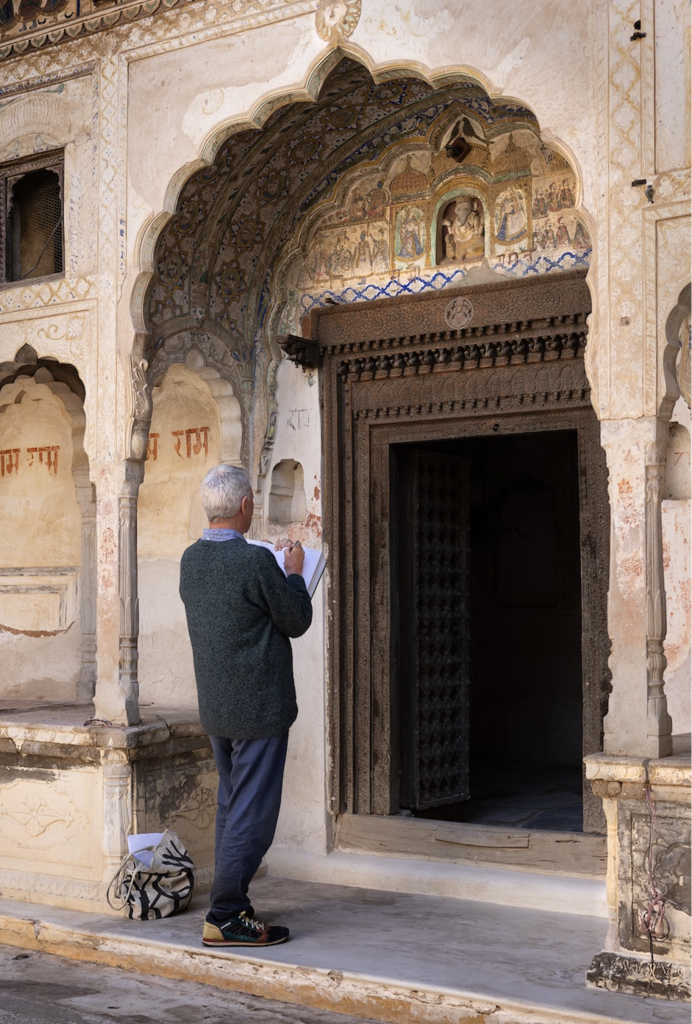
Drawing In Rajasthan
I carried a big Indian notebook [it’s actually an Indian accounts book with a green cloth cover decorated with fancy stitching and tied with a string] and I draw in it every day and record every journey, every town I visit, cows, temples, rickshaws, interesting people, landscapes… everything I want to remember and maybe use in my paintings. I really enjoy the car journeys and all the changing landscapes, and the villages and towns that you pass through, all the animals you see. It’s so thrilling when you see the first camels on the road… I immediately think: ‘at last we’re in Rajasthan!’
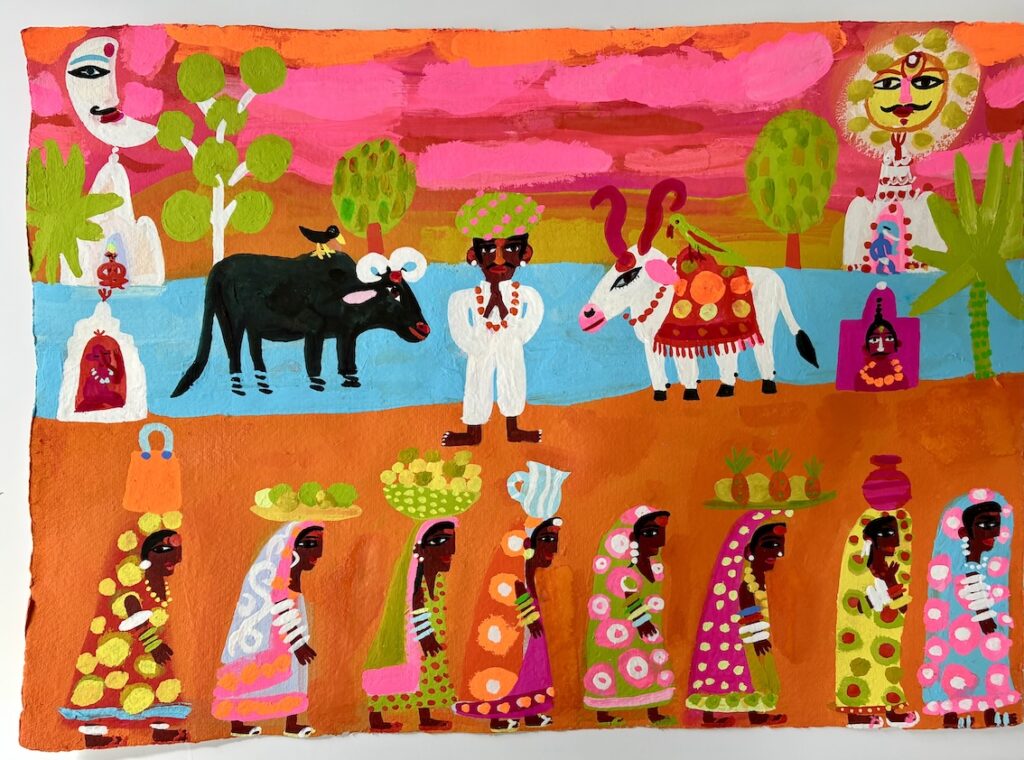
Procession By A River In Rajasthan
I like the arid desert landscapes with hundreds of brickwork kiln chimneys, so surreal like a painting by de Chirico. There are temples and hillside fortresses everywhere, even in the most isolated locations. I like the roadside messages you see: ‘We don’t own the Earth… we share it’; the rather ominous: ‘Concreting dreams since 1983’; ‘Rise Up Baby’, advertising Pepsi. I like the roadside billboards advertising men’s underwear: ‘Cozi Innerwear’; ‘Macho Sporto’; ‘Macho Comfy’; ‘Dollar Big Boss’ underpants. I have drawn many but now I need to paint them. I’ve never seen ads for women’s lingerie though there are plenty for cosmetics and hair products like the blue black: ‘Himalayan Hair Dye’.
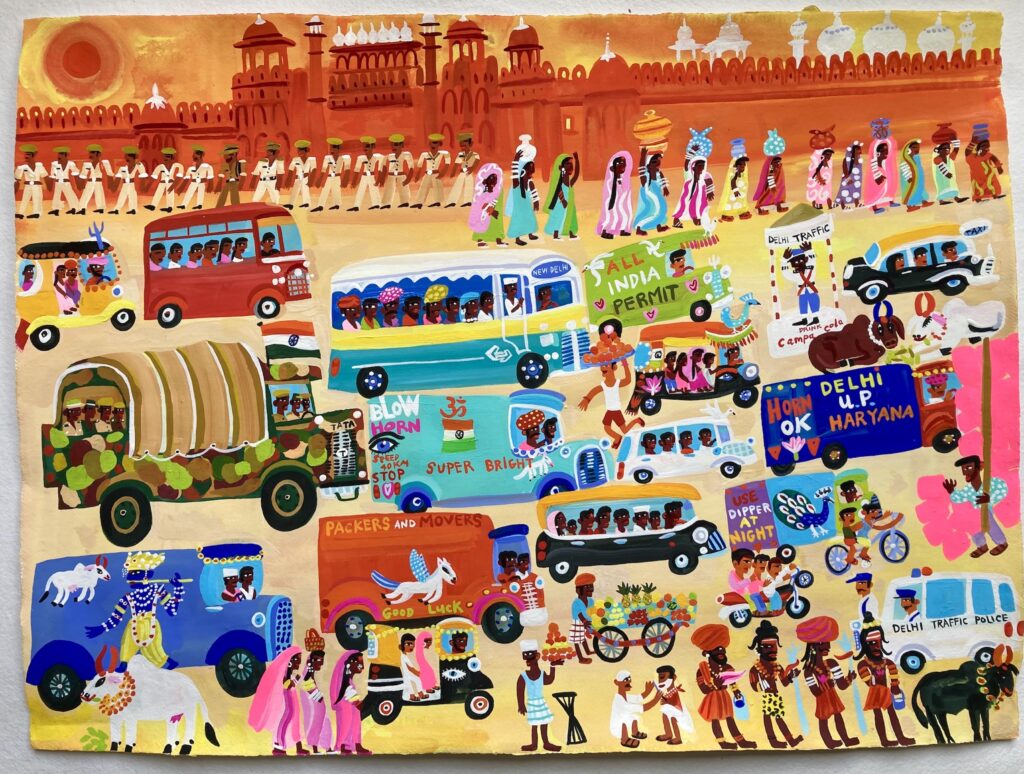
Traffic In Delhi
Indian traffic is slow and rhythmical. It weaves and twists and is noisy, lots of honking horns and melodic bells but it is never boring. People and animals move swiftly through it. At first it looks crazy, chaotic even, but after a while you start to see it as something almost musical. I like the way people decorate their trucks and vans with messages and flowers and gods and goddesses, with wild animals like tigers and lions. There is so much to look at in an Indian traffic jam. And the auto rickshaws!
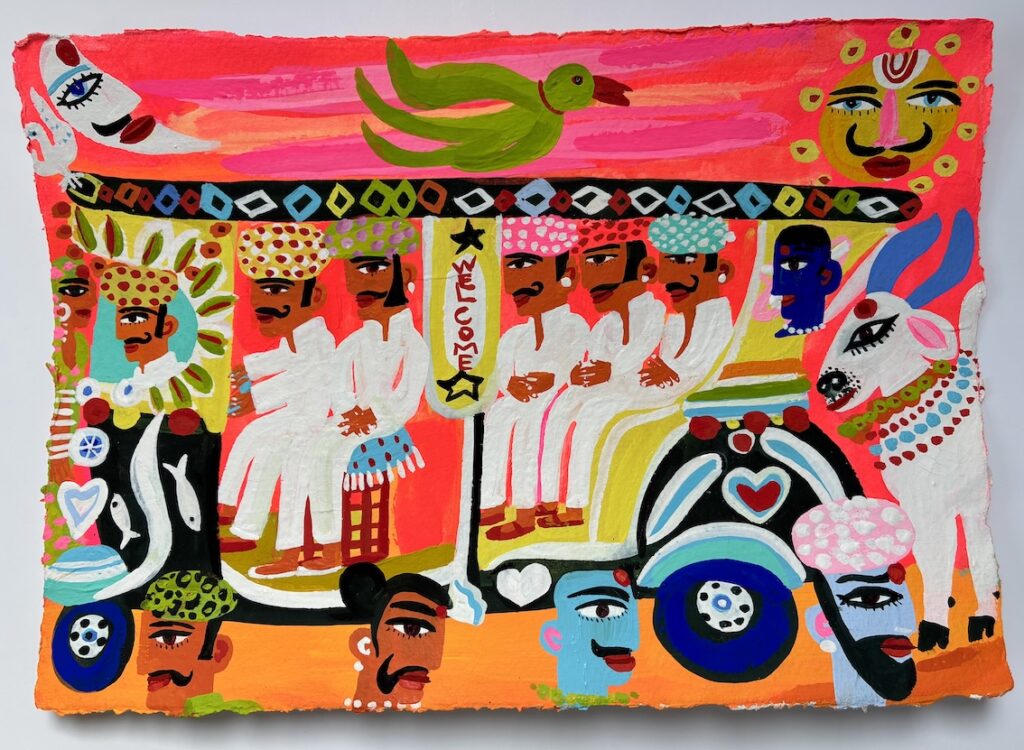
The Gentlemen’s Auto-rickshaw In Mukundgarh
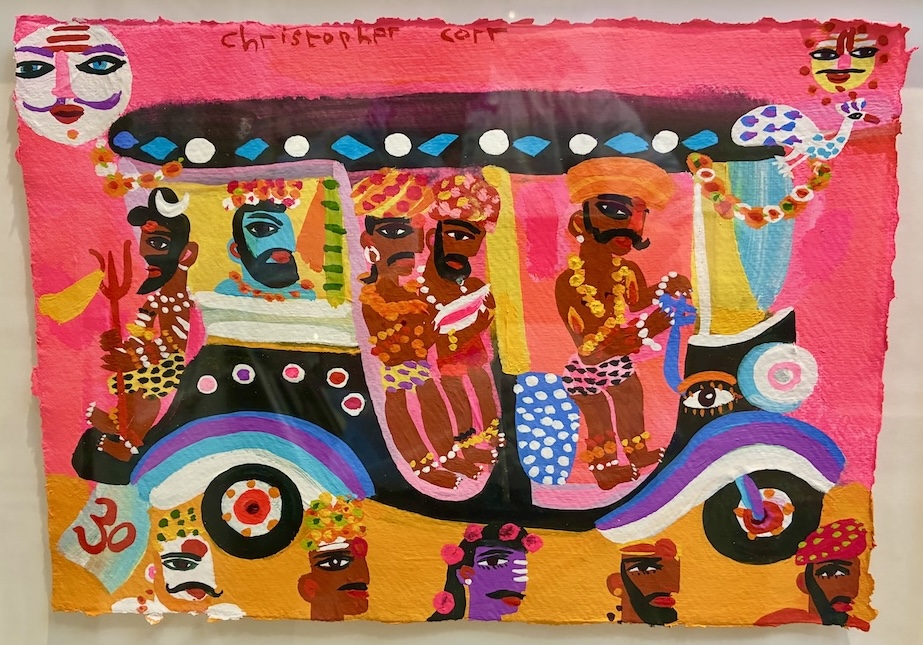
The Sadhu’s Auto-rickshaw In Mukundgarh
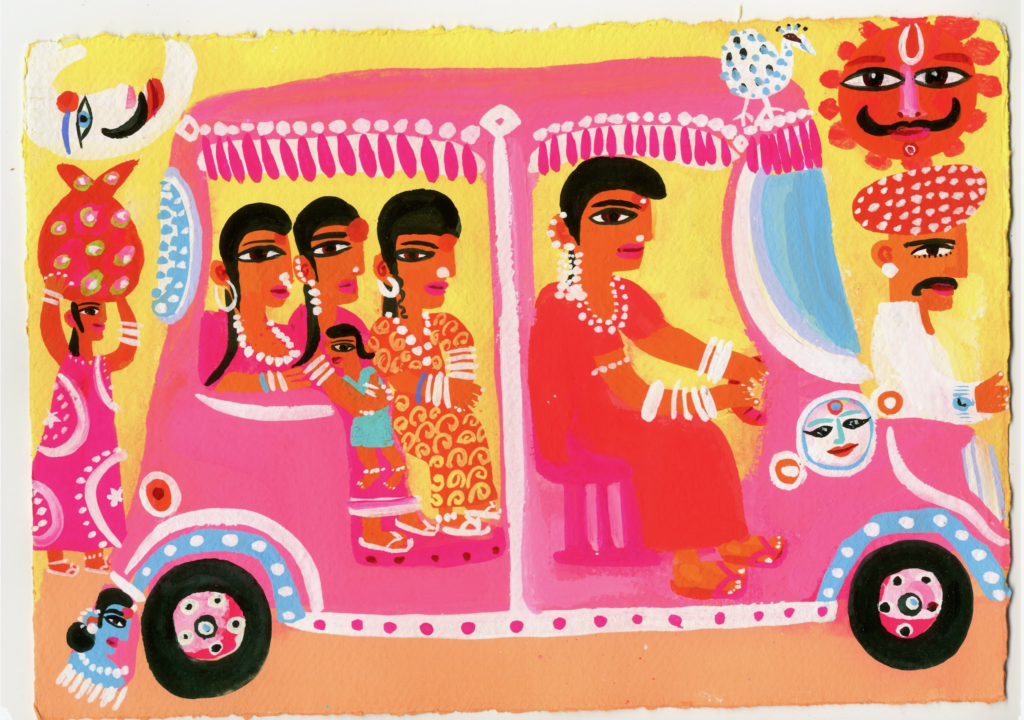
The Women’s Auto-rickshaw In Udaipur
Where do I begin to talk about auto rickshaws? They are pure Folk Art. The colours! The decorations in metal and paint and fabrics used to beautify and customise them so they will stand out from the rest. They are adorned in lucky symbols, hearts, diamonds, clubs, flowers, angels, Shiva’s trident, fishes, birds, and guitars. Some have curtains to ensure privacy for their passengers. I don’t ride in these ones because I want to see everything. When your rickshaw is careering around tight corners or overtaking slower traffic Ben Hur chariot races come to mind. In Udaipur you will see Ladies Only pink rickshaws driven by women.
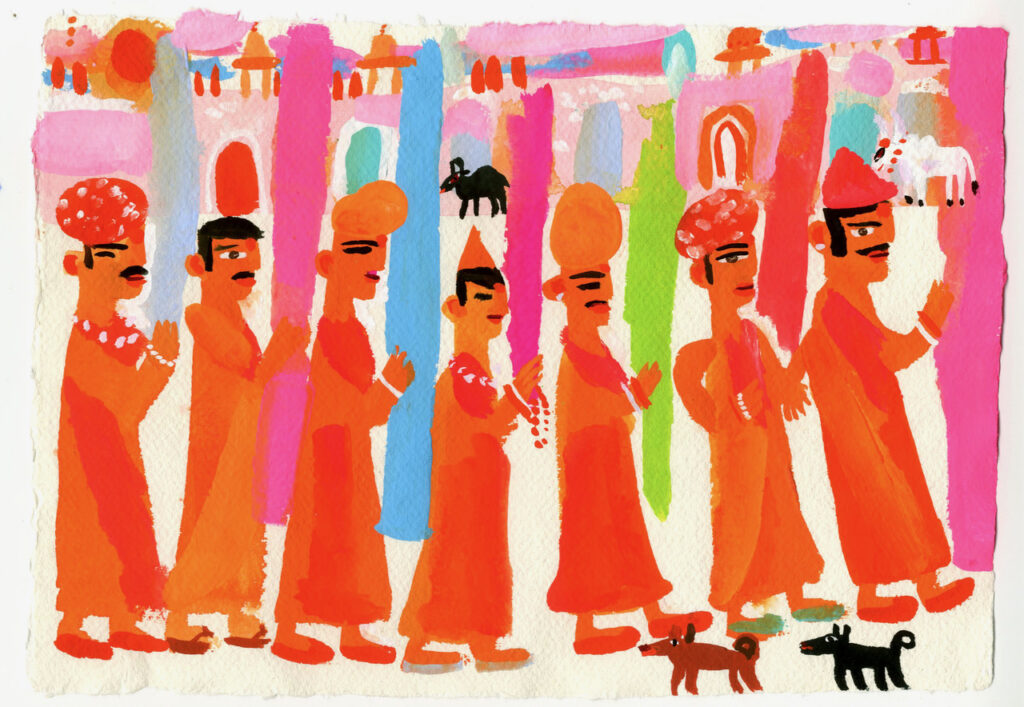
Pilgrim Procession In Jaipur
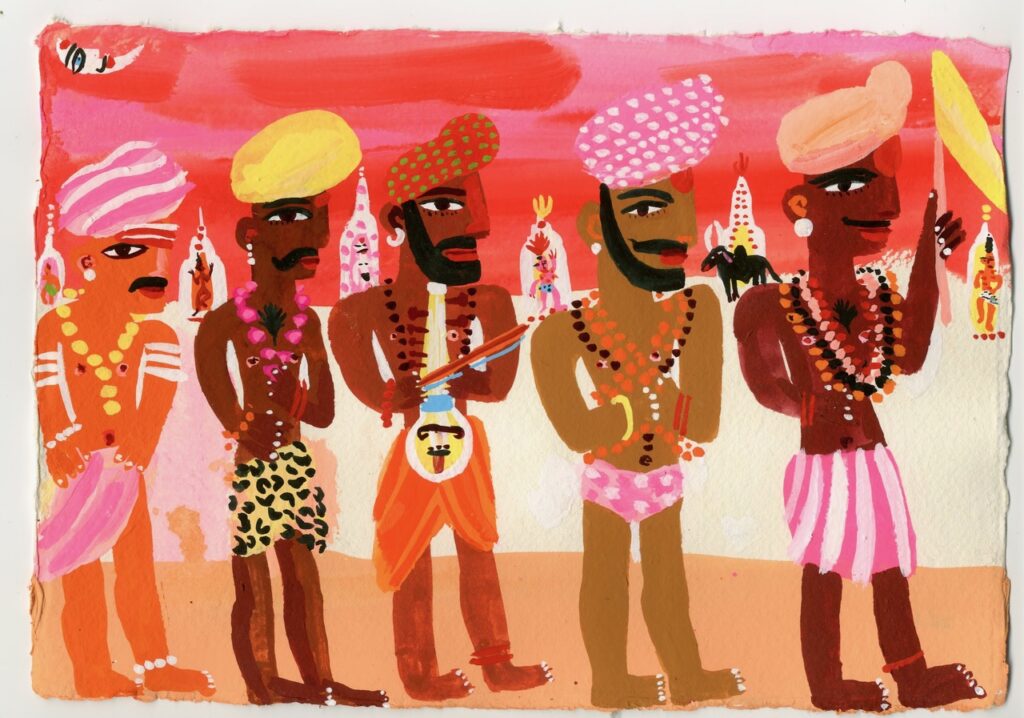
Five Sadhus In Jaipur
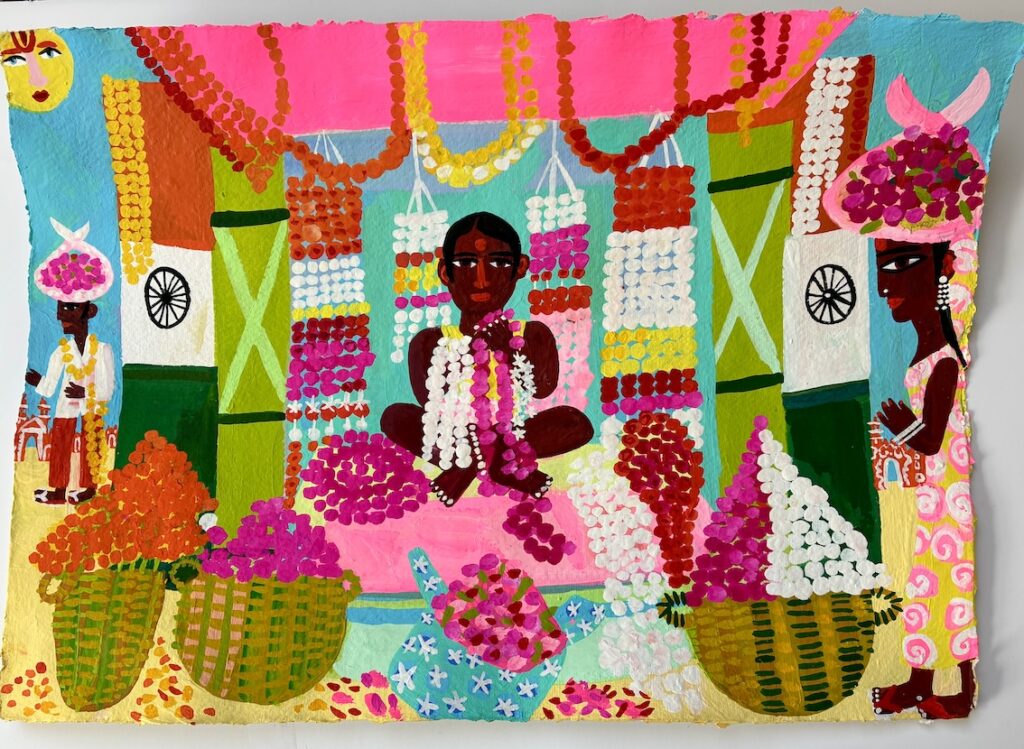
Flower Market In Jaipur
We visited Jaipur, the Pink City. I love its hot spicy orange pink colour, the walls and bustling city gates, the grid layout, the City Palace, so grand and stately, the astronomical sculptures at the Jantar Mantar Observatory completed in 1734. We went to the flower market to see huge bundles of marigolds and roses tied up in zingy silk cloths while all around people are weaving garlands of blooms and making up bags of petals for temples and celebrations. Early one morning we went south to Sanganer, a town famous for papermaking and textile dyeing. We saw washing lines of dyed fabrics drying in the sunshine. The paper mills use shredded cotton cloth to make big sheets of paper. We walked through rooms full of heaps of rag waiting to be sorted by colour & texture before being pulped. I bought several sheets of soft white cotton rag paper that is perfect for painting on.
To Amber with its imposing hill fort overlooking the lake where tourists leave their tour buses to view the spectacular scenery, and waiting snake charmers try to charm them to take snaps of their writhing cobras. There is a beautiful ancient stepwell next to a Shiva temple where you can see turtles swimming and sunning themselves on the stone steps.
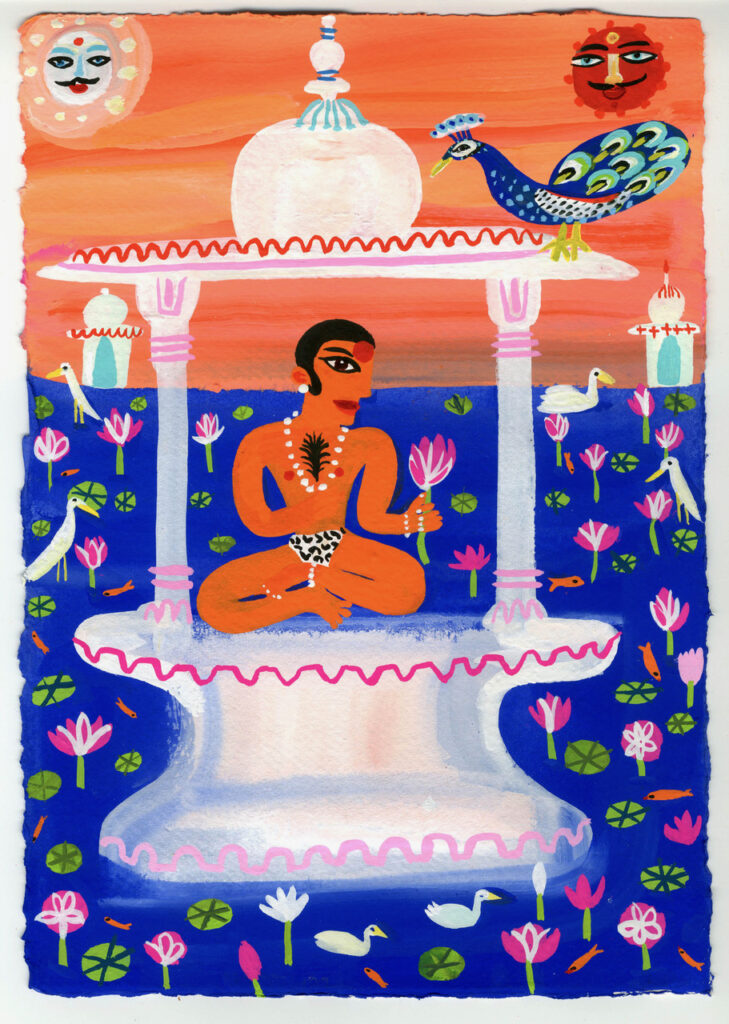
Sadhu In Bundhi
Bundi, in the south of Rajasthan, is a beautiful unspoilt medieval town with a huge fort and palace that loom over the town and the lake. In the early morning I watched hundreds of monkeys climb up from the lower town and up to the fort, some with little babies clinging on tightly as their mothers navigated the way over houses and hillsides up to the highest points of the ancient fortress. At night I watched huge bats flying out of caves in the lower walls of the fort. The town is the perfect size to explore on foot and has everything a good Indian town should have. The bazaar is small and fascinating and has a relaxed feel to it. Bundi has a number of stepwells, some very grand and others very scruffy, and plenty of temples in assorted colours and God affiliations. Holy men make processions through the streets. There are barbershops, tailors, music shops… everything I need.
Bundi is an ideal town.
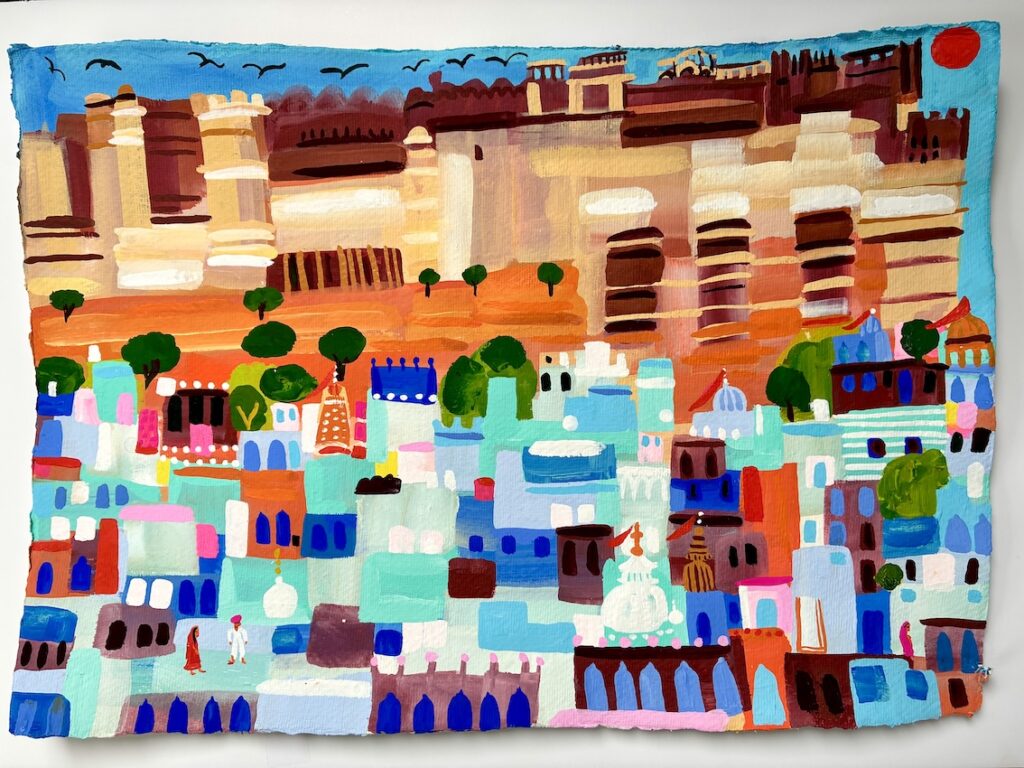
Mehrangarh Fort And The Blue City In Jodhpur
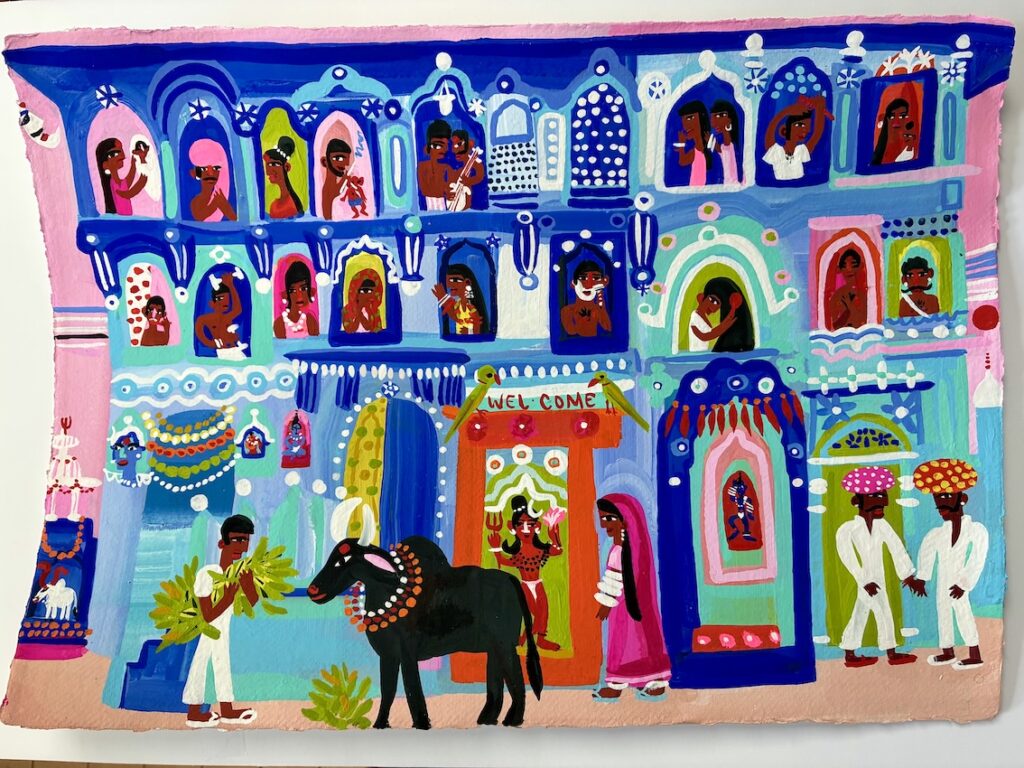
Early Morning In The Blue City
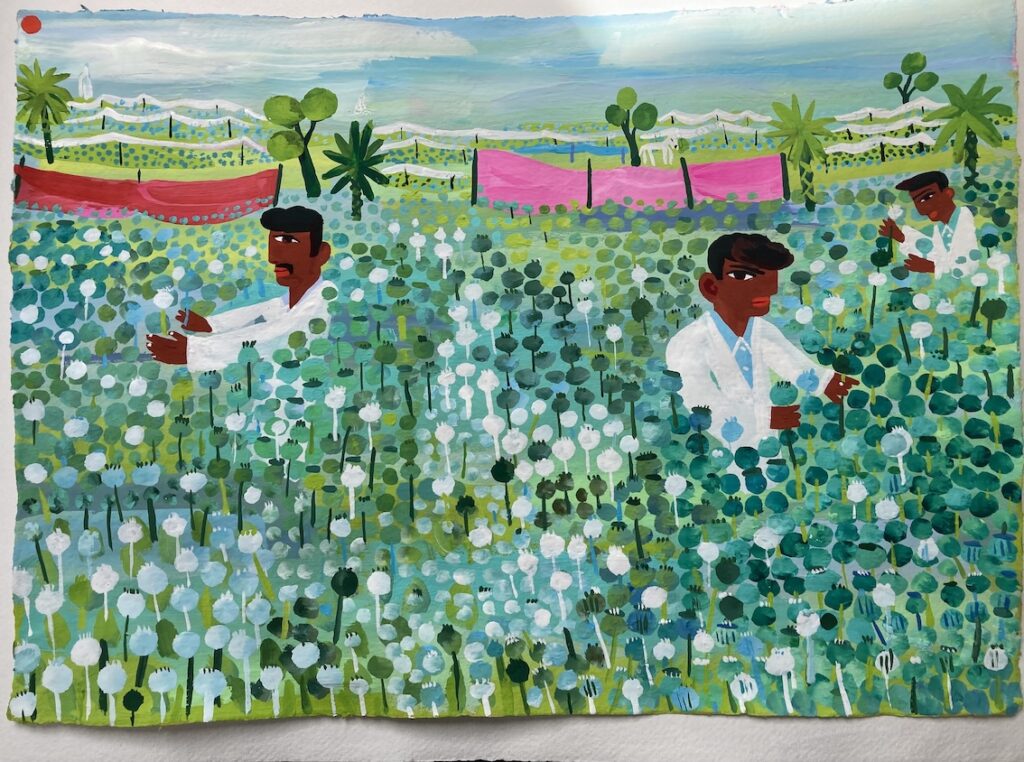
The Government Opium Fields In Rajasthan
En route to Udaipur and close to the hilltop fortress Chittorgarh I noticed a large number of opium poppy fields along the roadside. The last few white petals were clearly visible on the plump green flower heads. In a few fields there were government inspectors checking the crop to see if it was ready for harvest. The opium is used for medical purposes. It’s a profitable business for the farmers who are guaranteed a good price by the government for cultivating the crop.
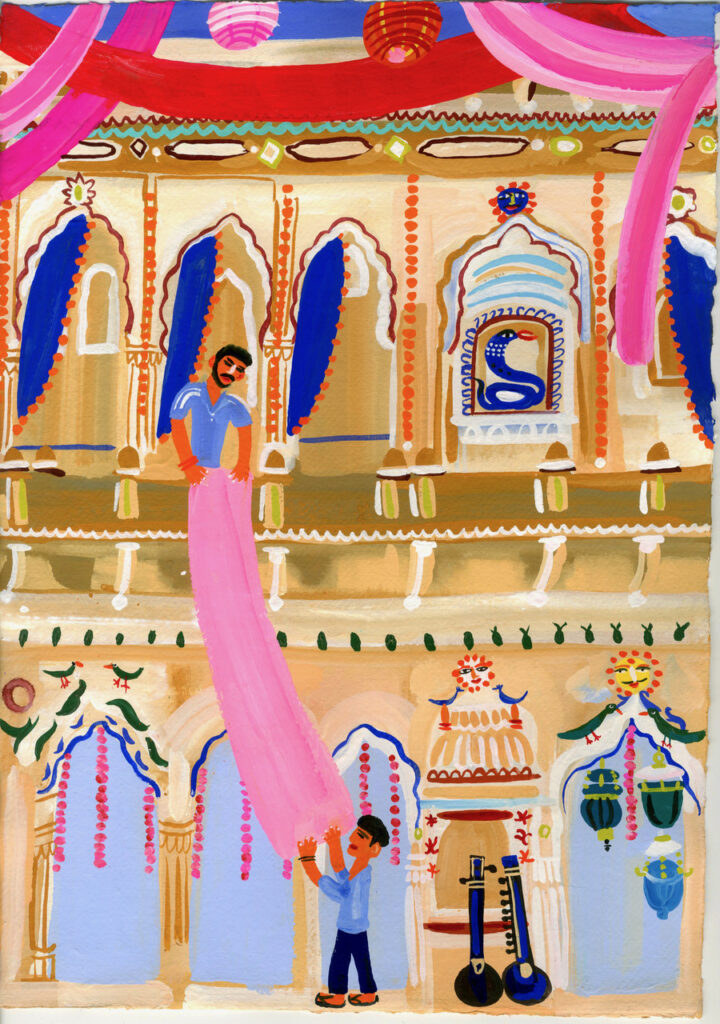
Decorating The Haveli For Holi
We arrived in Mukundgarh on the eve of Holi and the house looked stunning, decorated in pink silks and marigold garlands. Some musicians from the Thar desert were performing a concert of classical Indian music while in the next courtyard a troupe of desert dancers were getting changed into silk costumes of pink and gold. The men in huge turbans and the women in golden veils adorned themselves in weighty jewellery. Their dance performance told the story of Krishna and the gopis, who were the milkmaids he befriended. Their final piece was a dramatic peacock dance with huge peacock feathers shaking and flashing to the sound of crashing drums. The dancers disappeared behind a curtain and reappeared with sacks of orange and yellow marigold petals, which they threw around the courtyard and at the audience who sat politely around its edges. It became a huge floral battle and finished when everybody was completely covered in petals.
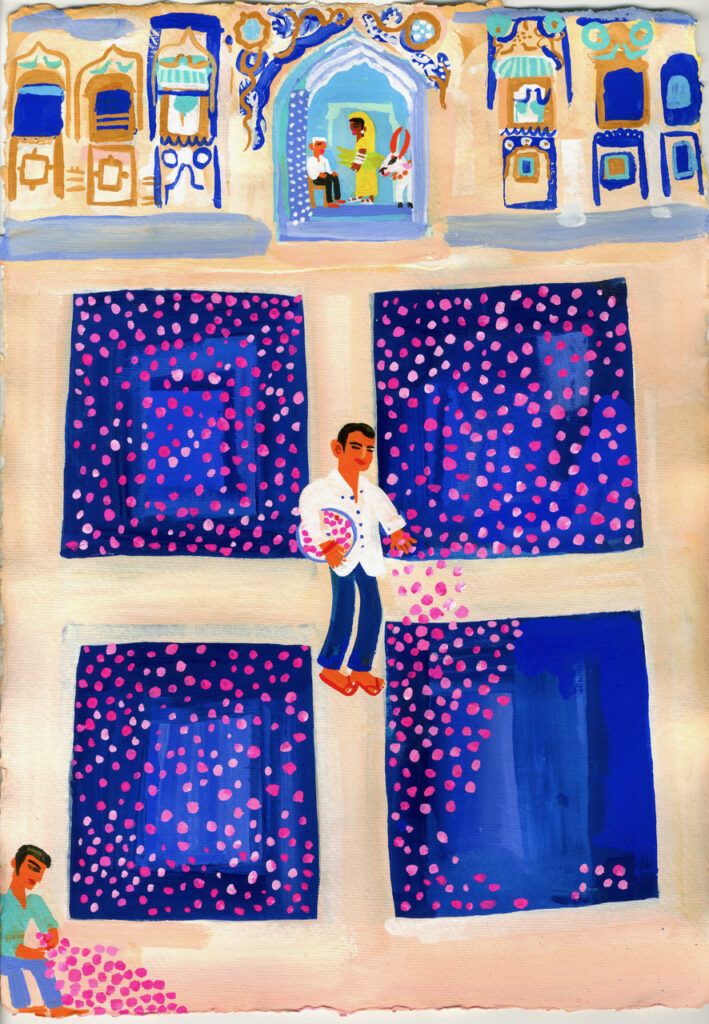
Tejvir Dropping Rose Petals Into The 4 Pools
The following day it was Holi, the festival of colour. Pankaj gave everybody in the house a set of cotton Holi clothes to wear. The festivities began soon after breakfast in the front courtyard with the 4 blue pools. The men of the house arrived looking very smart in their Holi suits with boxes of powdered colours, bright zingy fluorescent colours, and water guns and big syringes for squirting coloured dyes. I don’t know who threw the first fistful of colour but in seconds it became Technicolor frenzy. The air was choked with heavy clouds of pigment and people turned different colours. The 4 blue pools became a sludgy brown. Some of the house men poured buckets of coloured dyes from the roof onto the people below. It was like a war where nobody died but everyone got dyed.
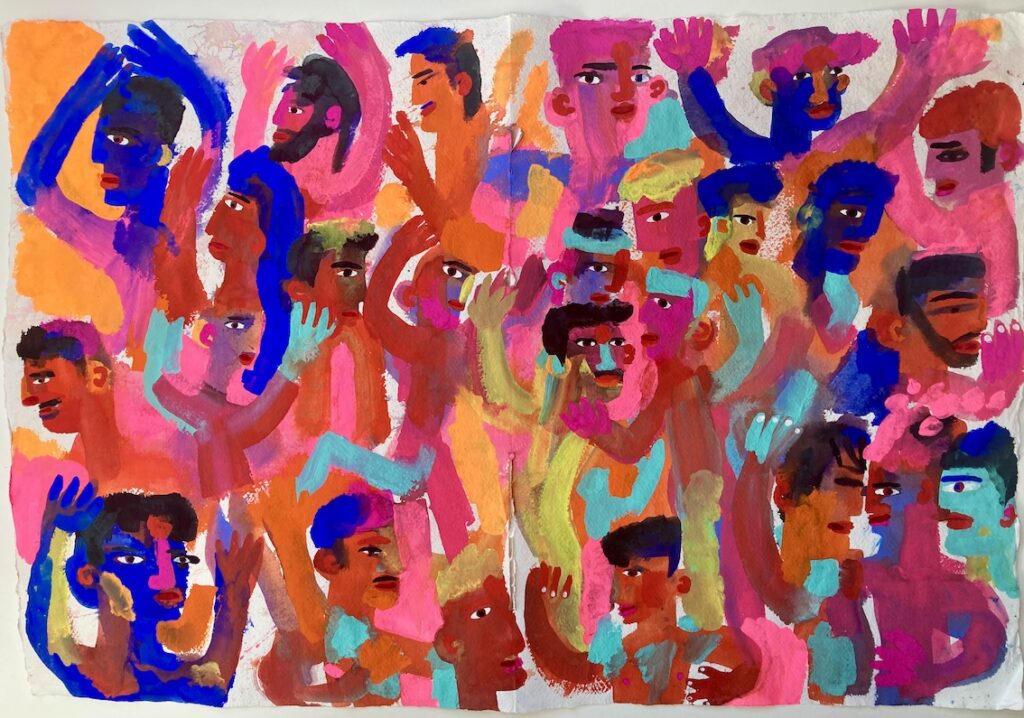
Holi At The Haveli
I sat in the shelter of a side area painting the scene until a woman appeared with a bag of blue powder and said ‘you look too clean!’ and poured it over my head.
The craziness lasted for about an hour or two and when it was over everybody was splattered and smothered in paint, drenched in every colour and looking unrecognisable. The battle was over and everyone was exhausted.
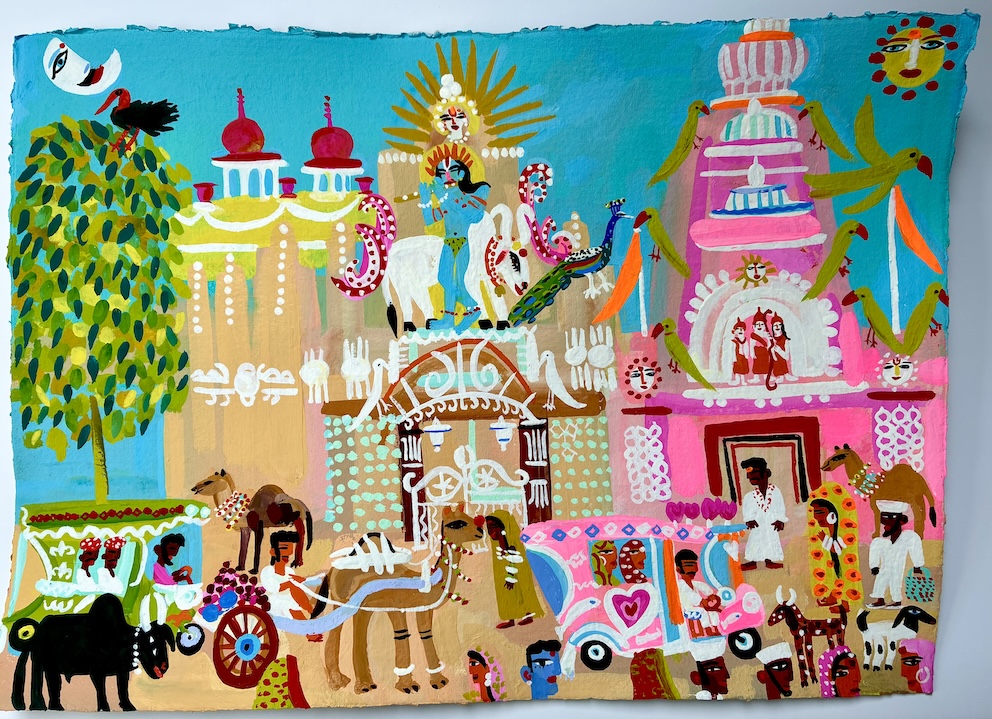
Traffic In Mukundgarh
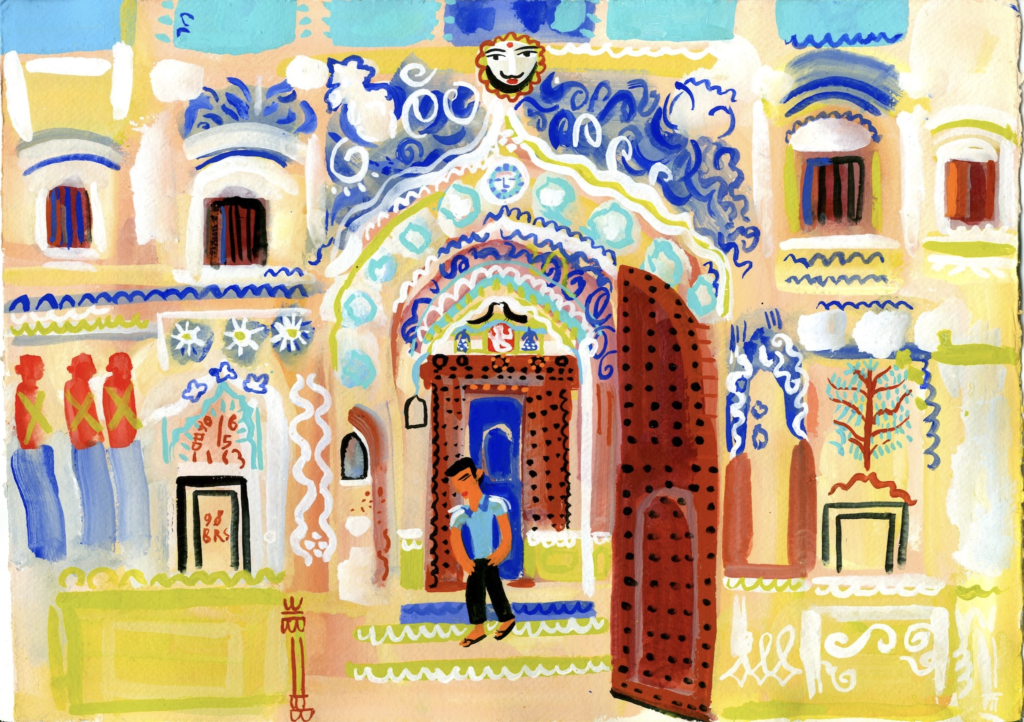
I mentioned to Pankaj that I was going to make a painting of the front of the haveli showing the main gate and all its ornate mural decoration and I asked him if I could take a chair outside so as to sit and get the best view. He set up a table and chair out on the street and moved his old red Ambassador car alongside me to shield me from any oncoming traffic.
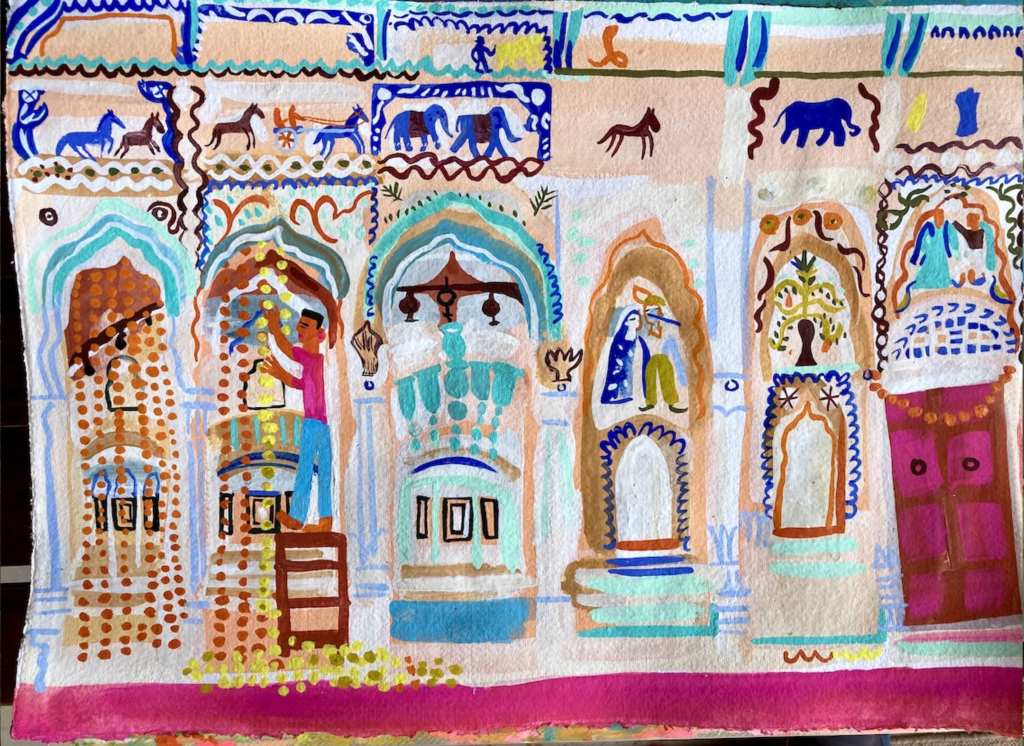
Decorating The Haveli
I painted several scenes around the house showing daily activities and preparations for Holi like decorating the house and cleaning up after the festivities were over.
The havelis in Rajasthan are decorated all over with murals showing scenes from The Ramayana with Gods and demons, heroic battle scenes, horses and horsemen, flying machines, the first trains, Hanuman driving a car, elephant and camel cavalry, political portraits of Gandhi, Nehru and others, lovers making love, Jesus smoking a cigar, men playing polo, women dancing, boxers and gymnasts… Neeraj asked me to paint something for them in one of the empty wall spaces and I must admit I felt a little apprehensive surrounded by all these wondrous scenes of Rajasthani life, culture and religion. I walked all around the house looking for a quiet niche in a hidden corner and I found a suitable space to paint a dancing Krishna.
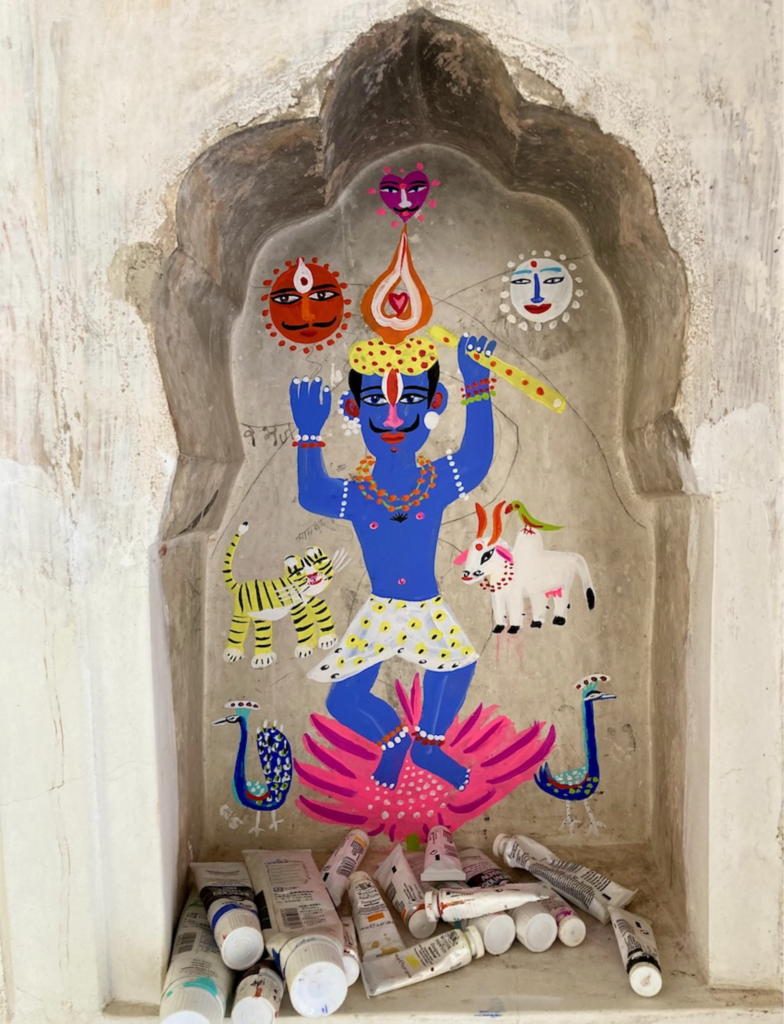
Pankaj found me mid-painting and said ‘This is your space now and you must decorate all these niches’… I counted about 35 empty spaces. I have been thinking about what I can do with the spaces and now I’m planning my next visit.
※
Christopher Corr / The Rowley Gallery
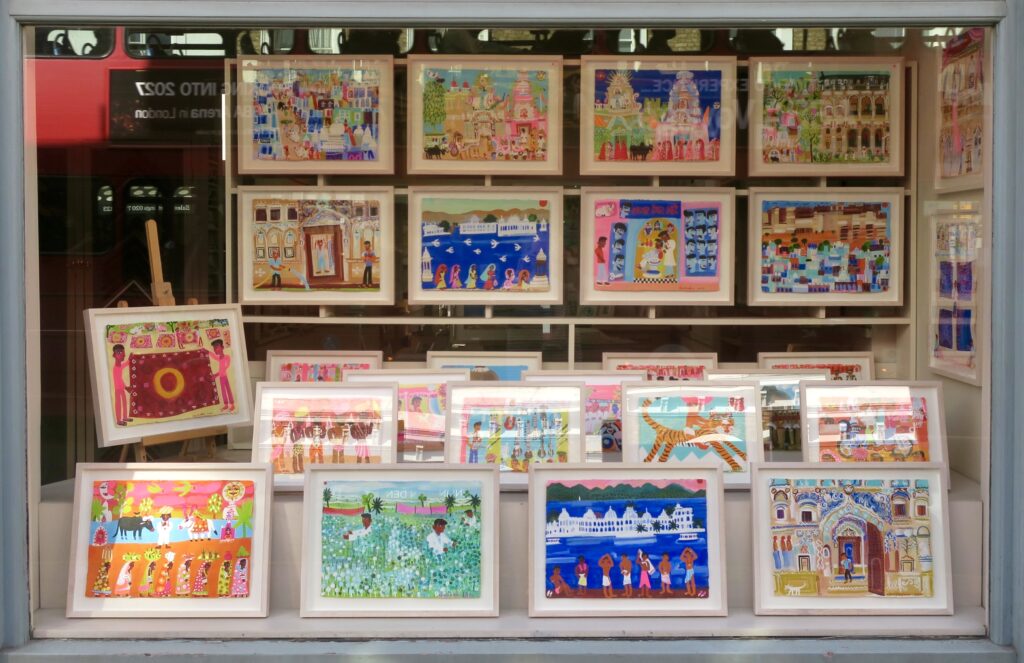
We’ve a windowful of Christopher Corr’s new paintings from India at the Rowley Gallery until the end of November. And a film by Naman Chaudhary.
